The Brutal Truths of PNW Policies
Part 2 of a 2-Part Column looking at the Mad-Scrambling Tax Policies in the PNW.
If we disagree to this point, let's start by agreeing on one thing: when states are facing massive budget deficiencies, it's not ideal timing to seek an overhaul of tax policy, especially when it involves having to go back on recent commitments to your constituents.
Here's where another football analogy is warranted: while we may not see eye to eye on how to design a smart offense (tax revenue generation), to have a winning formula the Pacific Northwest states must also consider their defensive strategy. As the great Paul "Bear" Bryant once said, "offense sells tickets, defense wins championships."
In this case, defensibility relates to a maniacal review of the effectiveness of past tax initiatives and the ongoing audit of every significant program in the budget to assess if are funds getting to the benefactors, if there are bad actors stealing from the state, and if adjustments must be made to programs to optimize impacts and minimize waste.
But much like football, in a game of inches (or billions), sometimes having the best offense & defense can't overcome the ugly turnover battle.
Turnover Will Lead to the Win or Loss
A complete overhaul of the tax code, should it be desired, should be employed through methodical, related movements that simultaneously combine new, well-rounded initiatives that can work together while abandoning old ones at the same time. Instead, Washington & Oregon continue to pass related & complex tax initiatives that mostly attempt to pull from the same honeypot: business owners.
That current honeypot is a growing beehive for both Washington & Oregon as they grapple with difficult budget decisions and growing distrust with their corporate taxpayers. But these deficiencies of budgets & a growing lack of affordability for their residents can be traced to decisions they've made in the past....and the ones they didn't.
First, let's get back to Seattle and their 35% downtown office building vacancy rate I referenced in Part 1. It's not just homelessness and lawlessness at play, it's economics.
As a business owner in Seattle, you'll collect and remit a state retail sales tax and you'll submit a gross receipts tax ("B&O") on the incoming revenue--this is before you've been able to take business expenses, even if you're a pass-through entity (you hire subcontractors, etc.). And, if your business does well after all of that and you make over $1m, you'll pay the new millionaire tax while also paying 7-10% capital gains taxes on any profits from dispositions of assets (stocks, business assets).
Washington scores 45th on the overall competitiveness of tax index, with corporate taxes rated as the 47th out of the 50 states (Oregon was rated as the 2nd worst competitiveness for corporate tax), and you can see why.
For those owning a business in Seattle specifically, though, it doesn't stop there.
The City of Seattle also has its own gross receipts tax for larger enterprises, and the payroll of employees have two taxes pending the overall level of payroll & employment numbers. Not to be outdone, the County also taxes businesses on what the business owners already own (furniture, equipment, vehicles, machinery etc.)....every single year.
The business owner then has the honor of paying a sales tax on all their purchases with money that has already gone through the fine filtration of government taxation, including the ones baked into prices since other businesses had to add taxes into the prices of their goods and services because of the B&O tax (much more on that below).
The result? Seattle businesses are burdened with some of the highest tax rates in the entire country (Seattle is ranked 99th out of 100th for business costs according to Wallethub).
Yet, despite alarming office vacancy and dwindling city payroll taxes, the recently elected Mayor's philosophy is based on solving this issue with a punitive stick. When pressed to explain the spiraling vacancy of downtown buildings, businesses under siege have said it's the taxes, but the new Mayor, Katie Wilson, apparently isn't interested in that explanation. Her concept, which she campaigned on, is in the way of a "vacancy tax", sold under the spirit of "progressive revenue."
This simply highlights the Mayor's disconnect in understanding how alignment and collaboration with businesses and their owners could help improve conditions, especially as many of these same businesses and their patrons battle persistent drug & crime issues in the streets. It's a simple equation that boils down to studying all tenses: reviewing past missteps, assessing current challenges without personal/professional bias, and speculating the best way to foster a flourishing & safe downtown.
If the Mayor gets her way, the resuscitation of downtown may not be feasible for decades.
Seattle's Mayor as Pat, Seattle Businesses as Puff
Diminishing Returns & Migration
The exodus of businesses from downtown Seattle may be an edge case, but it's also a cautionary tale: ignore the feedback and double-down on your vision and you will eventually have to answer to it downline, whatever it may be.
Such impacts from past visions have already come to roost at a regional level.
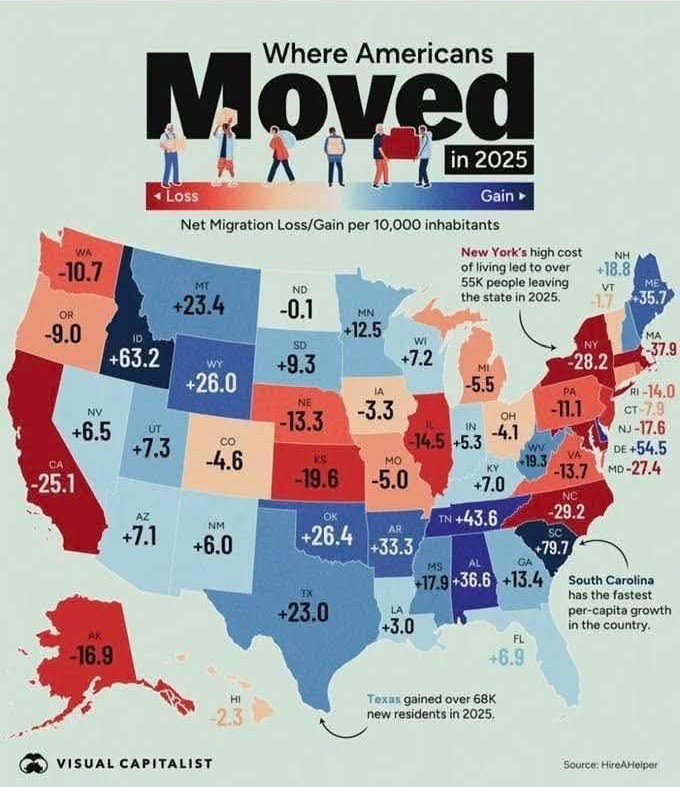
Oregon & Washington must face an important reality in 2026: as mobility from the work-from-home movement puts the tax base on wheels, households & income is more transient and volatile than ever before. That means WA & OR are competing with other states whether they like it or not, and so far, that's not netting out well.
The IRS shows the troubling trend from the migration net numbers via aggregated gross income for Washington, where the state saw over $2b in gross income leave from '21-'23 as Covid work trends emerged. Idaho was the benefactor of a lot of the defection. For Oregon, over $1 billion was lost in the same period.
When reviewing both states and ignoring the common back and forth moves between west-coast states (OR-WA-CA), Washington and Oregon saw over $10 billion in gross income leave for Idaho, Florida, Texas and Arizona over the 2-year period.
Shotgun Policies & Unintended Consequences
Right now, the overhaul of tax policy for Washington isn't reform. It's reaction.
The ugly truth related to Washington's Millionaire tax is that after a solid run of year-over-year sales tax gains, the state was panicking at the viability of their current tax codes & budget and they had to do something quickly.
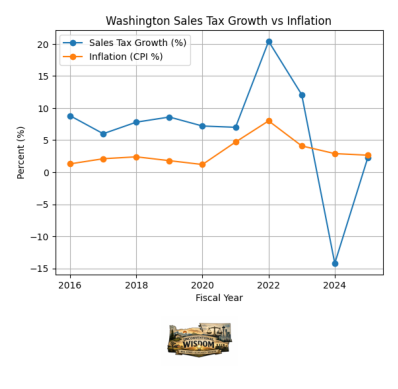
A big part of Washington's budgetary deficit is directly related to the slowing down of the pace of sales tax revenue collected. Looking beyond the '22-24 unevenness (due to Covid), having a flat collection revenue year in '25 (no change after inflation adjustment) is bad for the budget and shows troubling headwinds have emerged. And this is with a state budget that has seen Federal contributions double in the last 10 years.
As a sales tax state seeing dwindling returns, they have resorted to pulling every tax lever they could possibly deploy, and the scary reality is if sales tax collection continues to stagnate, and if inflation quickly increases again, the new taxes still won't be enough and policy makers will have to open the isolated income tax wider, confirming every fear of the millionaire tax opponents.
Even more frightening? The fine details of Washington's gross receipts tax policy has led them to rank as the 2nd most tax-regressive state in America as of January, 2024. Leaders for the state likely saw this report among many others and knew they needed to quickly address it, hence the onslaught of new tax programs targeting the high earners rather than coming to an epiphany that they contributed to that poor ranking through their past policies.
Oregon is in the same boat of tax panic. So much so they've even resorted to blocking Federal policies that provide tax relief to residents to prevent their overall income tax revenue from being negatively impacted. This also includes the sneaky bill, SB 1507, to block any Federal Tax benefits for startups in a state who has been attempting to build a robust startup scene for the benefit of jobs & credibility to attract new businesses. With only 13 taxable QSBS events per year, Oregon stands to lose significantly on the net result of this legislation, another example of not understanding the unintended net consequences of tax policy.
It almost begs the question if they simply just don't get it.
To help nudge them in the right direction, Oregon's Business Council recently provided a very compelling case to what Oregon must do at the state level in regard to their business climate, specifically what the state needs to refocus on and what is on the line. If this survey from 2024 has merit, Washington & Oregon are already reaping what they've sowed on the private sector front so they should listen to advice. If they don't, they may be competing with California for last place in the next survey, and that makes for a slippery slope as they're already losing ground on tax base migration.
It's All About Timing & Context
If you want the thesis of this 2-part column it's simple: as incoming tax slows and affordability issues persist, states who choose to enact a plethora of reactive tax policies while AI promises to sweep over their state with mass layoffs could quickly cause even more regression of revenue and impact their most vulnerable.
Often, it's not just the merit of the policy or the overall direction, but the timing of when it's being served.
If you're a personal connection of mine on Facebook you may have seen my rant at the timing of President's tariff policies last year. I thought the timing of the initiatives were downright terrible and I made that known. Regardless of if you thought it was the right thing to do overall, messing with a shaky economy still wobbling from inflation due to Covid printing presses, growing unaffordability and a plethora of other economic pressures at the time was bad policy.
One of my largest concerns was the ability for our government to thoughtfully review & make key adjustments with so many converging factors, especially when reporting always greatly lags conditions. When new, transformative policies are all made within 12 months of each other, like the State of Washington is doing (with each one that could have great impacts to the economy, positive or negative), the complex puzzle is never able to be accurately deciphered/analyzed because there isn't an effective way to study distinct causes and effects.
More simply stated: if you go ahead and modify your car to add to its speed by adding a new exhaust, performance chip, improved intake system and new spark plugs all at the same time, and it starts to sputter, do you know which part is at issue? Not without getting it into the shop and testing it. But you can't really take an economy off the road and into the shop; it's still driving at pedal-to-the-floor speed.
This then necessitates reactive guesswork & hasty policy, which is bad when we're talking illions of dollars....most likely with a "b".
It's not just unpredictability of the results from state initiatives: both WA and OR promise to see some pullbacks to their federal funds at the same time that makes the future even more cloudy. You can ask Oregon how it feels right now, as it's seeing a 2% reduction in the contribution from the Federal Government because of how their income tax policy is structured, leading to an almost $1B loss in revenue.
This is just the start, and the states have to plan accordingly. At the same time, adding many different new taxes simultaneously– many that will impact the employers of the state–is like Trump adding tariffs on the heels of 8% inflation and higher interest rates, amidst an affordability crisis no less. That strategy could (and likely will) lead to longer-term, collateral damage.
My Monday-Morning quarterbacking from my couch? The current economic environment requires a methodical, measured tax approach, one where adjustments can be made after insulated review, potentially centered on increasing taxes on already in-place measures and making thoughtful reductions in the budget, but being very careful to not introduce sweeping new policies during turbulent, high-stakes times.
Baby steps.
Cause & Effect: 2 Examples
I don't envy policy makers in '26. But they're also tasked with correcting issues that they contributed to, so I'm not so sure they have what it takes to lead more policy making to fix the current state of affairs.
Oregon is a prime example where they are attempting to fix issues they've created. When it comes to lying in the bed they made, I could link the PERS crisis as exhibit 1 for Oregon, but that would be too easy.
Instead, I'd like to continue to feature the most hiddenly regressive type of tax that many states use, including the PNW states: gross receipts taxes.
Example 1: The Oregon CAT, a Sneaky, Regressive Sales Tax
If you’re from Oregon, possibly you're familiar with Oregon’s Corporate Activity Tax ("CAT"), one that went into effect a couple of months before Covid. I sure am, as it was one of the main reasons I chose to leave the business of building new custom homes.
(Related & aforementioned, Washington has one of the highest in the nation. They call it the "B&O" tax.)
Oregon residents would never approve a sales tax, so the State of Oregon found their end around (their "Philly-Special" loophole) with the Corporate Activity Tax. The CAT did one thing extremely well: added costs to goods and services like a sales tax without a vote of the people.
The State of Oregon raked in a massive haul that helped them reach what is almost double the amount of annual tax receipts over an 8-year period.
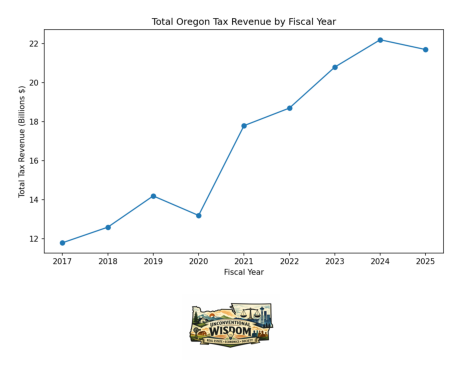
(*note: 2024 had a trigger to the kicker refund of $5b)
The CAT has created $6.5 billion over a 5-year period, all for Education.
(Washington's B&O Tax? $7 billion annually. WOW.)
But 6 years later? It’s not enough.
When it was passed, the CAT was positioned to make large corporations pay their fair share, but it hit us small business owners and our customers hard. It was then when I realized that I could no longer be a business owner, an advocate for my profession AND watch out for our clients all at the same time. With mounting industry regulation & frequent, dramatic code shifts, insurance stress, and macro & micro economic pressures were enough for indigestion already, the writing was on the wall with this tax: it would fundamentally alter affordability of homes, and when paired with misguided land use policy making, it would be the death knell to helping control costs for those who want to build or buy a home in the future (and that was before Covid).
Once it was enacted, the construction industry immediately started seeing the impacts to costs: every Oregon company involved in the production or distribution of any of the goods and services added a “CAT” surcharge to their invoice, (even many restaurants did).

I sat in astonishment when I added up a bill I got from our electrician: the electrician added .57% CAT surcharge on his entire bill—parts and labor—and his supplier had added that same surcharge. When added to our cost-plus contract (where we add our fee to all invoices and had to be ready to pay the tax, too), no longer was that tax .57%. It was a ninja-level tax where every level of distribution added it, a snowball rolling downhill that resulted in 4-5x the original .57% rate on a good & service.
This markup is happening throughout most businesses in the State of Oregon, and the tax on gross receipts has become a gross secret: taxing multiple layers of distribution with a tax was by design, and the covert, backend sales tax seeped into the cracks with almost everyone not seeing it. But it’s there, and it’s a significant contributor towards the growth of unaffordable housing as a result, an invisible poison that continues to hurt affordability. Such tax pyramiding doesn't help the consumer at any level and we're dealing with the effects now, but no one is talking about it because we need that billion $.
Example 2: Land Use Policy Straining Affordable Housing
Speaking of impacts to the consumer and affordability in real estate specifically, let's look at another example of policy makers creating their own mess and prescribing inadequate cosmetic fixes to a structure with a failing foundation.
The City of Eugene, OR had not expanded their Urban Growth Boundary for single family residential growth since 1984, and a 20-year land supply is required by Oregon law.
After multiple inquiries from the State, the City began a program called “Envision Eugene”, a convoluted process of identifying need for land that commenced when I was President of the Home Builders of Lane County.
That was 2010ish, when everyone in any kind of real estate business was being financially suffocated. We all held out hope for the brighter days ahead, and we knew when that day came, we desperately needed land inventory. It was our lifeblood, and our community hadn’t stopped growing even though our household earnings & housing supply had.
Unfortunately, we knew it was a longshot considering the City of Eugene was vocal that it preferred not to expand. So, after the 7-year ruse they miraculously found proof of a 20-year land supply. The process was marred with misrepresentation & a lack of good faith, one where land conservation groups closely worked with the city to identify land they could identify as “potentially dividable”, even if it didn’t conform to developable standards. They ended up deciding to only expand the UGB for other uses outside of residential and here we are, 42 years since the last expansion, still waiting for viable residential expansion to deliver new residential parcels to build upon.
A decade removed and following principles we learned in Econ 101 class, supply has lagged demand, and costs have quickly risen as a result. Not only would more land have resulted in more of a supply of housing, expanding the UGB had great opportunities to carve out sections of affordable housing for the next 20 years and would have allowed intentional planning of parcels for all types of inventory needs. The right proposal had been discussed during early task-force meetings but ended up being discarded.
Ever since, due to lack of building supply and a changing industry, the last 15 years has seen builders exiting the business in droves, with an estimated only 20% of the new, SFD builders in Eugene who were active in 2010 being active today and very few properties left to be built on. After much resistance from the community, developers don't have the appetite to create more land either, and it has left public building permit offices underperforming in revenue, subcontractors closing or consolidating, and very little new single-family dwellings being constructed.
This has been happening statewide as the state is in a full-fledged housing crisis, and both the city and state have finally been acknowledging that a lack of supply is the biggest issue. What they aren't saying is that their continued public planning policies of the past took the construction industry for granted, and that their allergy towards any type of growth was the root cause of it all. Their hope now lies in continued density initiatives, but desperate measures like this cockamamie program proposal will do nothing but push our state's spiral even deeper.
"Housing first" should have been many, many years ago and construction shouldn't have repeatedly been viewed as the cash cow when it came to new taxes & fees. Unfortunately, the milk has all but evaporated.

Taxing to Cure While Ignoring Deeper Factors
To help affordable housing, a complexly layered dilemma, some cities have resorted to adding excise fees to fund new housing initiatives by burdening the reeling new construction segment, they have created state policies to add more multi-family density that often ignore sound siting policies, and they resorted to passing a law to override decades-old planning principles to allow for low-income housing to be placed in areas where commercial zoning exists, misrepresenting community planning promises and contradicting state planning initiatives related to walkablility in the process.
All because they didn't plan well enough during land allocation & planning sessions and refused to enlist appropriate expansion when times required it.
Speaking of Eugene, there are a dozen examples of the cause and effect that have built a layer of plaque in the arteries of progress in residential construction: from unrelenting increases of cost due to overreaching state building codes, to skyrocketing costs of SDC fees and prolific protesting/legal challenges to land creation by regional nonprofits and empowered neighborhood organizations, unaffordability and the lack of built supply has had many contributors.
But now it's hard to look towards the residential construction industry for money & lean on them for solutions because state & city governments have effectively put the Golden Goose on life support through over-regulating and under-prioritizing. That's tough when more units are needed now more than ever before.
To illustrate the point, here's one sample of a growing issue: skyrocketing permit & SDC fees that push economics beyond feasibility for many builders trying to keep prices lower.
These are permit costs for a 3,600 square foot home in the City of Eugene, OR, in the same neighborhood over 15 years: 2010, 2016, & 2025.
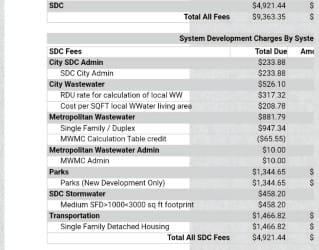
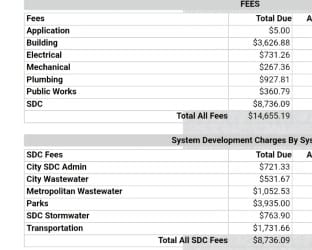
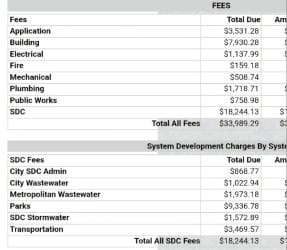
Oregon's average cost to build increase over the 15-year period? 73.8%
Overall building permits of the same sized house in the same area? 263%.
The increase in SDC fees? 271% increase.
As part of the SDCs, funding for new parks grew an astonishing 594%, almost a 7x increase.
The skyrocketing cost of construction through a myriad of saddled fees could be a post all in itself, and this is long enough, but the case has been made: housing first should be more than a slogan but a framework.
Washington & Oregon: Something’s Gotta Change
When developing tax policy our governments frequently ignore that they often are helping solve one crisis while spawning another. The biggest question is if leadership has any idea that they've had a hand (or two) in it, a realization they have failed to dig into real solutions to the fundamental issues that plague affordability and long-term stability.
It gets back to the very beginning point: trying to cure symptoms without solving the root causes that are contributing towards negatively impactful, unintended consequences that have established what is now deep systemic issues.
I'm afraid Washington will soon be back in the same place they are now: they will trade one tax revenue for losses in revenue in other areas and it will trickle down to those it was designed to help, the lower & middle classes, further solidifying their ranking on the regressive tax index. With the current and upcoming reality for employers shifting daily, and as we enact tax layering policies, this combination of quick change will blur the future & effectiveness of incoming tax gains, especially if the tax base erodes.
Ultimately, someone will foot the bill, and it will likely be you.
If we truly desire to find meaningful fixes to affordability, we must examine what are heavy, hidden impacts beyond the obvious (overspending, fraud, inflation, & waning federal funding assurances), and must confront the brutal truths with honesty. At times, that may mean an acknowledgment of the deeper issues from the past that continue to pull on affordability, even if it's a system that some of our current leaders created. Again, it all starts with accountability, and that is highly uncommon throughout every level & affiliation in politics.
The best way to get to healthy, outside of ridding waste & fraud to optimize dollars spent, is to continue to foster tax policies that are the best balance of fixing the past, addressing the present, and planning for the future bumps in the road. In a time with so many economic pressures, the solution lies in truly examining the state’s finances, reviewing what’s working and what isn’t, and making refinements. Meanwhile, there has to be a fundamental understanding and focus by both Oregon & Washington to do what they can do to support the growth & retention of their businesses for the benefit of jobs & tax revenue, rather than continue going back to the well and adding any taxes they can come up with.
After all, that well may end up going dry.